From Backyard Wire to Africa
From Backyard Wire to Africa: My First DX Contact in Africa⌗
There’s something uniquely satisfying about building a station with your own hands—especially when that effort turns into a signal traveling thousands of miles across the globe. This past week, I finally got my HF setup fully on the air, and it paid off in the best possible way: my first contact into Africa—working D2UY in Angola on FT8.
Here’s how it all came together.
Building the Station⌗
The heart of my setup is the Icom IC-7300, paired with an MFJ-993B automatic tuner and a DX Engineering MBVE-5A vertical antenna installed in my backyard.
I wanted something that would perform well across multiple HF bands without requiring a massive footprint. A multiband vertical checked all the boxes—but as I quickly learned, the antenna itself is only half the story.
! ⌗
⌗
The Real Work: Radials, Radials, Radials⌗
If there’s one lesson that kept coming up in research (and in conversations with other hams), it’s this:
A vertical antenna is only as good as its ground system.
So I committed to doing it right.
I ended up laying down:
-
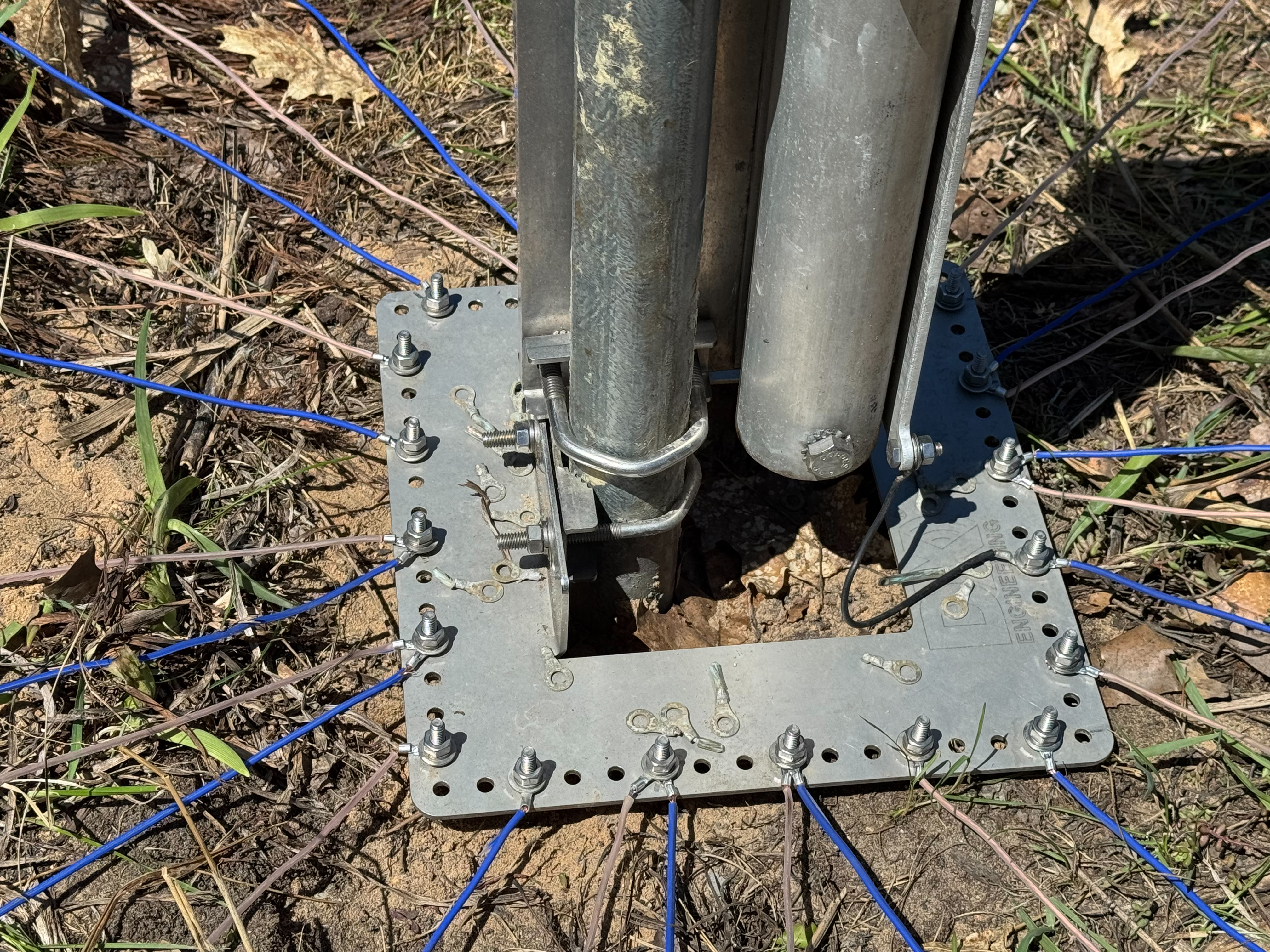
28 radials
-
Each approximately 65 feet long
That’s over 1,800 feet of wire spread across the yard.
It wasn’t glamorous work. It meant hours outside measuring, cutting, routing around trees, and stapling wire into the ground. But it was absolutely worth it.
This radial field dramatically improves efficiency—especially on the lower bands—and helps ensure that more of the transmitted energy actually radiates instead of being lost in the ground.
!
! ⌗
⌗
Running the Feedline⌗
From the antenna, I ran approximately 85 feet of coax into the shack, entering through a window pass-through. Inside, I used a short patch cable to connect everything cleanly to the tuner and radio.
Keeping the feedline straightforward and minimizing unnecessary bends or stress points helped keep things clean and predictable.
Station Setup and First Power-On⌗
With everything connected—radio, tuner, antenna, and grounding—I powered up the station and started tuning around the bands.
The MFJ-993B made quick work of matching the antenna, and the IC-7300’s waterfall display immediately brought the bands to life. Signals were everywhere.
After all the planning and installation, this was the moment where it finally felt real.
Dialing It In⌗
Before transmitting, I spent some time:
-
Checking SWR across bands
-
Listening to band activity
-
Getting familiar with signal levels and noise
Everything looked solid. The radial system was doing its job, and the antenna was behaving exactly how I’d hoped.
The Moment: First FT8 DX Contact⌗
Then came the highlight.
While operating FT8, I decoded a signal from D2UY in Angola, South Western Africa. Even seeing that callsign pop up on the screen was exciting—Africa from a backyard vertical felt like a big milestone.
I answered the call.
A few transmission cycles later, the exchange completed successfully.
That was it—confirmed.
A low-power digital signal, sent from a vertical antenna in my backyard, had made it across the Atlantic and into Africa.
!
Why FT8 Made the Difference⌗
FT8 is uniquely suited for this kind of contact:
-
It can decode signals well below the noise floor
-
It uses precise timing and structured exchanges
-
It allows reliable contacts even with modest stations
In other words, it’s the perfect mode for squeezing performance out of a backyard setup.
What Made the Difference⌗
Looking back, a few things really stood out:
1. The Radial System⌗
This was the single biggest performance factor. Putting in the time here paid off immediately.
2. A Simple, Clean Setup⌗
No unnecessary complexity. Just a solid antenna, a good tuner, and a reliable radio.
3. Digital Mode Efficiency⌗
FT8 enabled a contact that might have been difficult—or impossible—on voice with the same setup.
Lessons Learned⌗
-
You don’t need a massive tower to work DX
-
Ground systems matter more than most people think
-
FT8 is incredibly powerful for weak-signal work
-
There’s nothing like that first intercontinental contact
What’s Next⌗
Now that the station is up and proven, the focus shifts to:
-
Improving grounding and noise reduction
-
Expanding into other digital and voice modes
-
Logging more DX contacts
Final Thoughts⌗
There’s something incredibly rewarding about seeing your signal come back from halfway around the world—especially when you built the station yourself from the ground up.
From laying radials in the yard to completing an FT8 contact with Africa, this has been one of the most satisfying projects I’ve taken on.
And it’s just getting started.